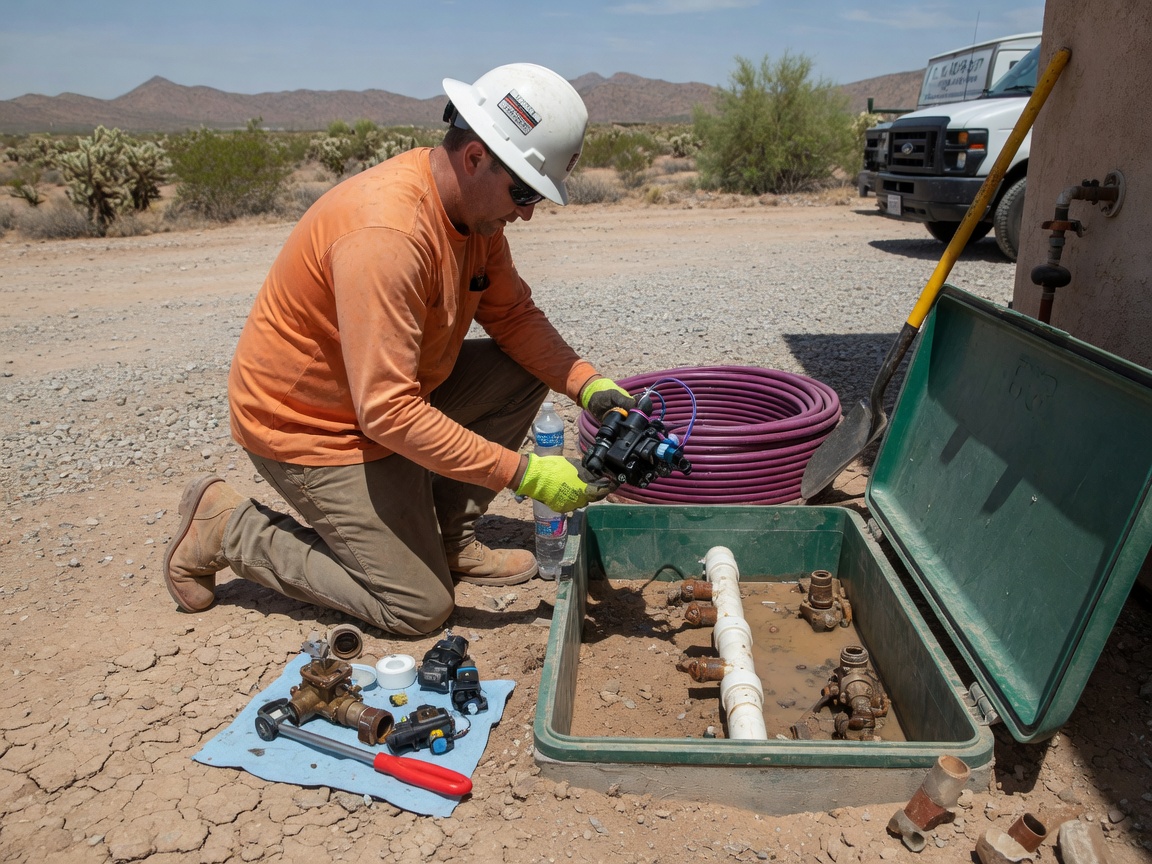
Tucson homes built from the 1970s through 1990s in neighborhoods like Midtown and the East Side often have original irrigation valves that fail from mineral buildup in the city’s hard water supply. These valves sit in underground boxes that fill with monsoon debris each summer, making solenoid failures and diaphragm tears common. Replacement requires shutting off the main line at the backflow preventer, excavating compacted desert soil, and installing new brass or heavy-duty plastic valves rated for high pressure swings between 40 and 80 psi.
Pima County irrigation systems tied to drip zones for desert-adapted plants need valves with flow control that can handle low-volume schedules without leaking past the seat. Older galvanized manifolds in areas near 22nd Street corrode at the threads, so full manifold replacement is sometimes required rather than swapping a single valve. Technicians check for electrical shorts in the common wire caused by ground moisture after heavy rains before closing the box.
Proper replacement includes verifying the new valve matches the existing pipe size, usually ¾-inch or 1-inch PVC, and testing each station at the controller to confirm no cross-flow occurs between zones. Skipping a pressure test after backfilling can leave leaks that erode the soil under patios common on Tucson’s East Side.
Technician insight
In Tucson the thing that catches most people out with irrigation valve replacement is how fast monsoon silt packs the valve box and grinds the solenoid plunger; we see it every year on East Side homes where the box sits lower than the surrounding grade.
East Tucson valve failure after monsoon
A homeowner near 22nd Street reported one zone running constantly after heavy rain. We found the valve box full of silt that had jammed the diaphragm open. After replacing the valve and raising the box slightly above grade, the system held pressure and the zone shut off cleanly.
Irrigation Valve Replacement Services We Offer
✓Solenoid Replacement
Swap failed solenoids on existing valves to restore zone control without full valve excavation.
✓Diaphragm and Seal Service
Replace worn internal diaphragms and seals that leak after years of hard water exposure.
✓Full Valve Manifold Upgrade
Replace corroded multi-valve manifolds in older Tucson homes with new brass assemblies.
✓Valve Box Repair and Relocation
Repair cracked boxes or move them away from high-traffic paths and monsoon wash areas.
✓Drip Zone Valve Conversion
Convert standard spray valves to low-flow drip valves suited for desert landscaping.
Irrigation Valve Replacement Cost in Arizona, Tucson
| Service | Typical Range | What Affects It |
|---|---|---|
| Single valve replacement | $175–$350 | Standard ¾-inch valve in accessible box |
| Manifold replacement (2-4 valves) | $400–$750 | Includes new brass manifold and box |
| Solenoid only | $95–$160 | When valve body is still good |
| Valve box relocation | $250–$450 | Moves box out of walkway or wash path |
Ranges are typical for Arizona, Tucson and confirmed with an exact written quote before any work starts.
How it works
- 1
Locate And Isolate
Identify the failing valve using the controller, then shut off water at the backflow preventer near the meter.
- 2
Excavate And Assess
Open the valve box and dig out compacted soil to expose the manifold and check for corrosion or debris.
- 3
Remove And Replace
Cut out the old valve, install the new unit with proper thread sealant, and reconnect wiring.
- 4
Test And Backfill
Run each station from the controller, check for leaks, then compact soil and secure the box lid.
Pricing
Most residential irrigation valve replacements in Tucson fall between $175 and $550 depending on access and manifold condition.