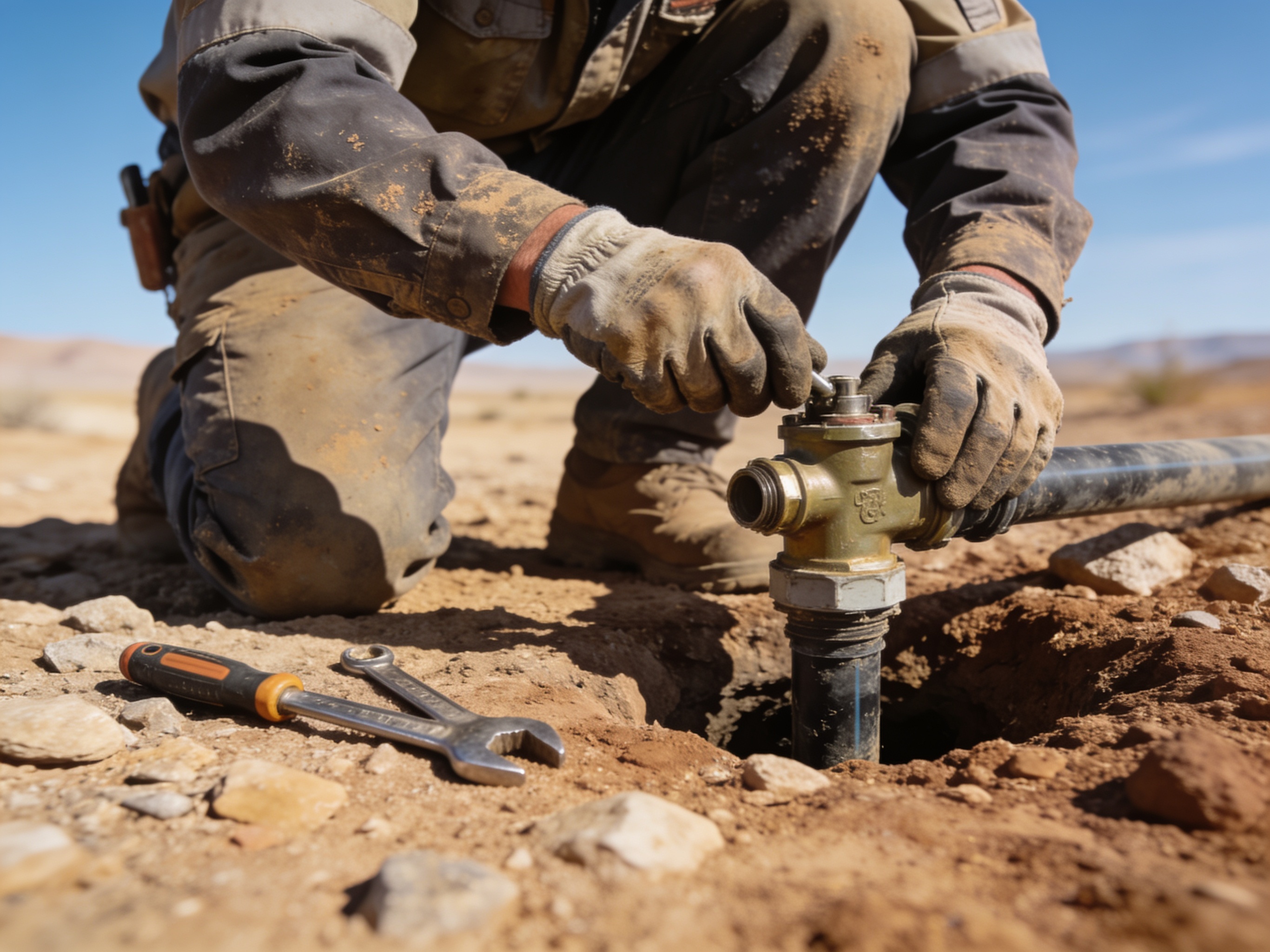
Tucson’s older housing stock in areas like El Con and the Sam Hughes neighborhood often has original 1980s and 1990s irrigation manifolds buried under caliche and decomposed granite. These valves sit in shallow boxes that fill with monsoon debris and fine silt carried by the Rillito River watershed, causing the solenoid plungers to stick or the diaphragm seats to erode. When a valve fails to shut off completely, the resulting constant drip wastes several hundred gallons per week on properties with mature citrus and mesquite plantings.
Hard water from the Central Arizona Project and local wells deposits calcium scale inside the valve body and on the flow-control stem. This scale prevents the bonnet from sealing evenly and can crack plastic valve bodies during the rapid temperature swings between 105-degree summer days and cooler monsoon nights. Technicians working out of the 7240 E 22nd St shop carry both brass and heavy-duty plastic replacement valves because many East Tucson homes still have mixed piping that requires adapters to avoid leaks at the transition points.
Code compliance in Pima County requires backflow prevention assemblies on every irrigation system; a leaking valve upstream of the assembly can create pressure differentials that pull contaminants into the potable line. During repair we always test the backflow device and note any required upgrades before closing the box. Homeowners in the Catalina Foothills and Tanque Verde corridors frequently request same-day service when a stuck valve runs overnight and creates muddy patches that damage stucco foundations or walkways.
Terrain on the east side slopes gently toward Pantano Wash, so gravity can push water through a partially open valve even when the controller is off. We routinely install flow-control adjustments and check for downstream elevation changes that affect shut-off reliability. These site-specific details determine whether we rebuild the existing valve or replace the entire manifold assembly.
Technician insight
In Arizona the thing that catches most people out with irrigation valve repair is monsoon silt that packs the boxes along 22nd Street and in the Sam Hughes neighborhood; homeowners think the valve is bad when it is simply buried in fine sediment that keeps the solenoid from seating after the first big rain.
Stuck valve after monsoon in El Con
A homeowner on 5th Street noticed one zone running constantly after the July rains. We located the valve box filled with silt from the nearby wash, found the diaphragm coated in calcium scale, rebuilt the valve on site, and added a deeper gravel base so the next storm would not flood it again.
Irrigation Valve Repair Services We Offer
✓Solenoid Replacement
Swap failed 24-volt solenoids that no longer open or close the diaphragm, restoring zone control without full valve replacement.
✓Diaphragm and Seal Rebuild
Clean scale, replace worn rubber diaphragms and O-rings inside existing valves to stop constant seepage common in Tucson’s hard water.
✓Valve Box Cleaning and Drainage
Remove monsoon silt and debris from valve boxes, add gravel bases, and improve lid fit to prevent future flooding and solenoid corrosion.
✓Pressure Regulator Adjustment
Tune downstream pressure on older manifolds to protect valves and emitters from the high city supply pressure found in many Tucson neighborhoods.
✓Complete Valve Manifold Replacement
Remove and replace multi-valve assemblies in aging East Side systems when multiple zones fail or boxes are too deteriorated for repair.
Irrigation Valve Repair Cost in Arizona, Tucson
| Service | Typical Range | What Affects It |
|---|---|---|
| Solenoid replacement | $175–$275 | Includes testing and one valve; additional valves add $75–$110 each |
| Diaphragm rebuild | $225–$325 | Per valve; scale removal and new seals included |
| Full valve replacement | $325–$475 | Brass or heavy plastic; price rises with box depth or pipe transitions |
| Valve box cleaning and drainage upgrade | $150–$250 | Often combined with valve work; gravel base and new lid |
Ranges are typical for Arizona, Tucson and confirmed with an exact written quote before any work starts.
How it works
- 1
Locate And Expose Valves
Use wire tracing and site maps to find every valve box on the property, then clear lids and surrounding soil without damaging wiring.
- 2
Diagnose The Failure
Test solenoid voltage, check for debris or scale on the diaphragm, and measure static and dynamic pressure to identify the root cause.
- 3
Perform Repair Or Replacement
Rebuild or swap the valve, adjust flow control, and verify downstream zones operate correctly before restoring the box.
- 4
Test And Document
Run each zone through a full cycle, confirm backflow protection, and leave a written summary of work performed and any recommended follow-up.
Pricing
Most Tucson valve repairs fall between $175 and $475 depending on access, number of valves, and whether a full manifold swap is required.