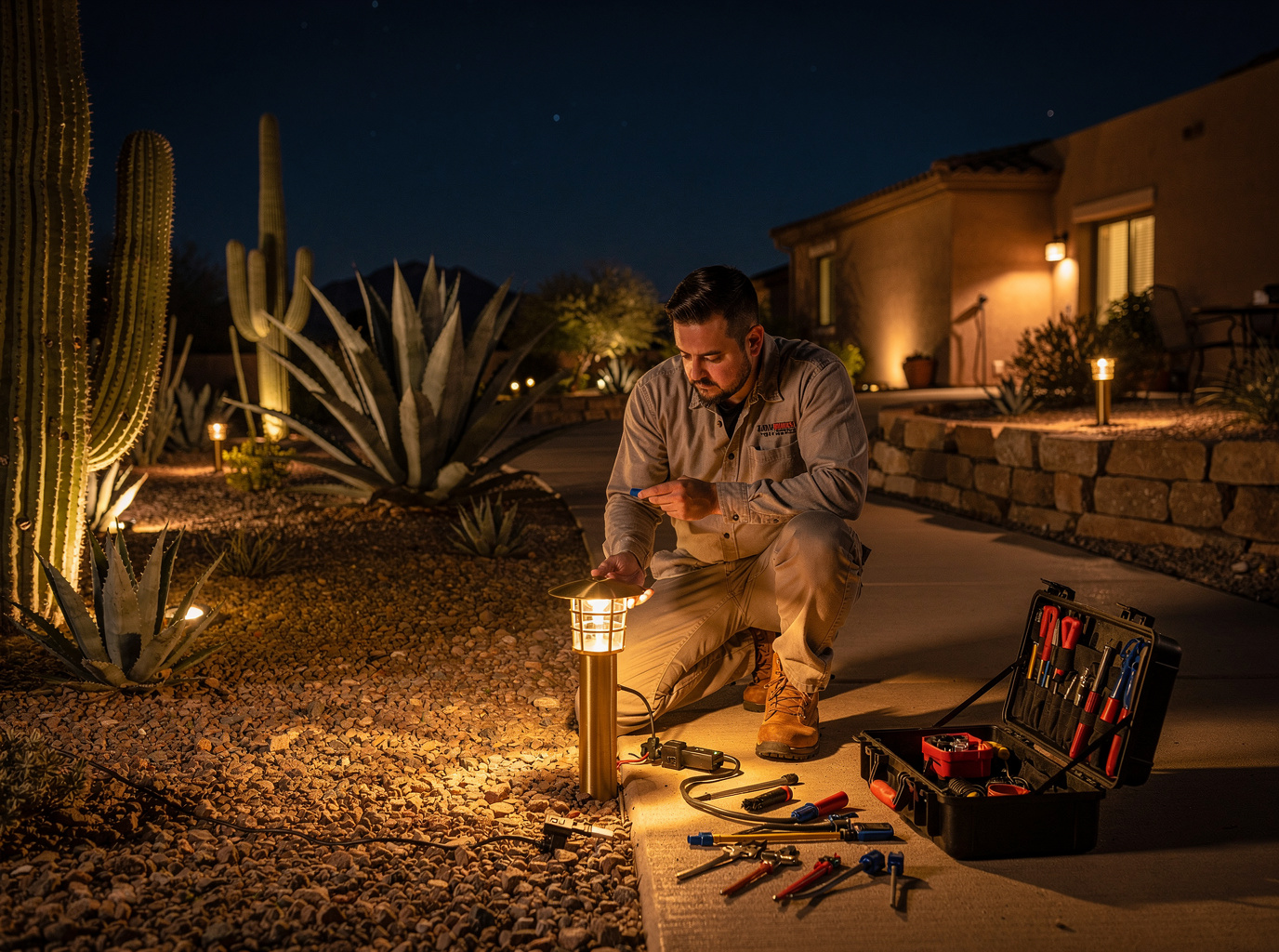
Tucson summers push fixture temperatures past 110 degrees, melting cheap plastic housings and baking wire insulation until it cracks. Monsoon season then drives water into those cracks, shorting transformers and GFCI outlets. Older East Tucson homes from the 1970s and 1980s often run 16-gauge wire that cannot handle today’s LED loads or the voltage drop common on longer runs across sloped lots.
We trace breaks with a tone generator instead of guessing, then splice using direct-burial connectors rated for constant ground moisture. Transformers mounted on south-facing walls fail fastest; relocating them to shaded north walls or inside ventilated boxes cuts repeat calls. Low-voltage landscape lighting also shares trenches with irrigation lines in many midtown yards, so we map both before any digging to avoid cutting drip tubing.
Code requires all exterior lighting to be on a GFCI-protected circuit. Many Tucson properties still use unprotected 120-volt feeds installed before the requirement, creating shock hazards during rain. We update these circuits and label every junction box so future irrigation work does not accidentally energize lighting lines.
Technician insight
In Arizona the thing that catches most people out with landscape lighting repair is how fast monsoon water finds the hairline cracks created by last summer’s 115-degree days; once it reaches the transformer the whole zone dies and homeowners often blame the timer instead of the melted insulation on south-wall mounts common in East Tucson homes built in the 1980s.
Midtown Tucson Monsoon Short
A 1984 home near Campbell and Grant lost half its lighting after a July storm. Tone tracing showed water had entered a cracked 16-gauge run shared with the drip system. We replaced the damaged section with 12-gauge direct-burial wire, moved the transformer to a shaded north wall, and added GFCI protection. The system has run without issues through the following two monsoon seasons.
Landscape Lighting Repair Services We Offer
✓LED Fixture Replacement
Swap failed or faded fixtures with corrosion-resistant LED models that withstand Tucson UV and heat while cutting energy use.
✓Transformer Repair and Upgrade
Test output, replace burned taps, and upgrade undersized transformers that cannot handle added fixtures or voltage drop on larger Tucson lots.
✓Underground Wire Tracing and Repair
Locate breaks caused by irrigation trenching or monsoon erosion, then splice with waterproof connectors rated for direct burial in Arizona soil.
✓Timer and Photocell Replacement
Install weatherproof digital timers and photocells that survive dust storms and temperature swings without drifting or failing during monsoon season.
✓GFCI Circuit Upgrade
Add required GFCI protection to older 120-volt landscape lighting feeds still common in 1970s-1980s Tucson neighborhoods.
Landscape Lighting Repair Cost in Arizona, Tucson
| Service | Typical Range | What Affects It |
|---|---|---|
| LED Fixture Replacement | $85–$160 | Per fixture; higher for custom or hard-to-reach mounts |
| Transformer Replacement | $250–$450 | Includes new multi-tap unit sized for existing load |
| Wire Tracing And Splice | $175–$350 | Price rises with depth and distance from access points |
| GFCI Circuit Upgrade | $300–$500 | Includes permit where required in Pima County |
Ranges are typical for Arizona, Tucson and confirmed with an exact written quote before any work starts.
How it works
- 1
Site Assessment
Walk the property at dusk to identify which zones are out, check transformer output, and note any shared trenches with irrigation lines.
- 2
Fault Location
Use a tone generator and probe to trace breaks without unnecessary digging across established desert landscaping.
- 3
Repair Or Replace
Splice damaged wire with direct-burial connectors, replace failed fixtures or transformers, and relocate units away from south walls where possible.
- 4
Testing And Handover
Run the system through multiple cycles, verify GFCI protection, and show the homeowner the labeled junction locations.
Pricing
Most Tucson landscape lighting repairs fall between $200 and $650 depending on wire access and whether a transformer must be replaced.