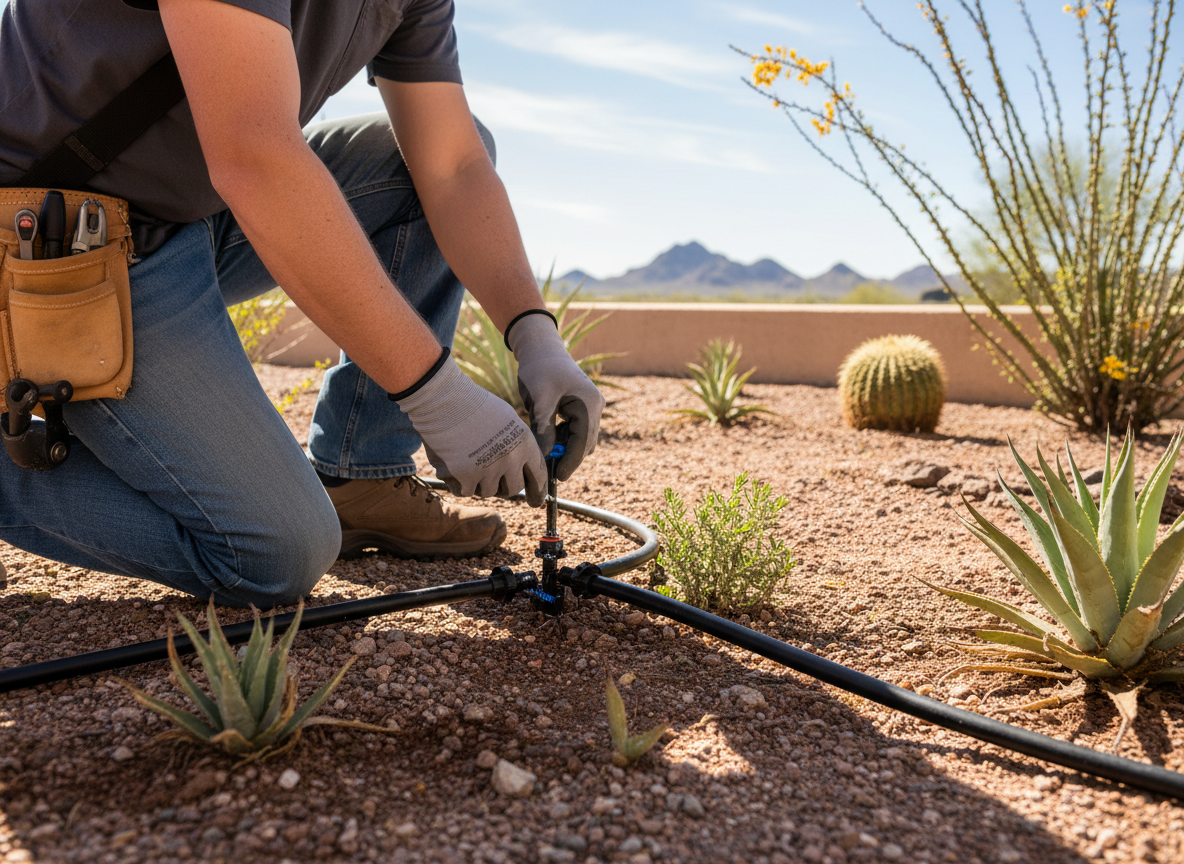
Tucson’s hard water and intense summer heat quickly clog drip emitters with mineral buildup, especially on older East Side properties near 22nd Street where systems installed in the 1990s still use 1/4-inch tubing. Technicians often find emitters blocked at the barb connection or cracked from UV exposure after years of 110-degree days. Proper repair requires flushing lines with a mild acid solution before replacing emitters rather than simply swapping parts, or the same clog returns within weeks.
Pima County soil shifts during monsoon season, pulling emitters out of alignment on sloped lots in areas like Vail and the Catalina Foothills. We check pressure at the valve box first because Tucson water pressure can spike above 80 psi after city line work, blowing out new emitters. Every repair includes verifying the filter screen at the backflow preventer to prevent repeat failures.
Homeowners on the East Side frequently mistake emitter failure for a controller problem when the real issue is crushed tubing under gravel paths or root intrusion from desert willows. We trace each zone back to the manifold using a pressure gauge and replace only the damaged sections instead of the entire run. This targeted approach keeps costs down while restoring even coverage across the landscape.
Technician insight
In Arizona the thing that catches most people out with drip emitter repair is assuming the clog is just at the emitter when the real problem is scale built up inside the 1/2-inch supply line running under the gravel on East Side lots. Once summer heat bakes that line the minerals set hard and no amount of new emitters will fix the flow until the main line is flushed.
East Side Tucson home with dead patches
A homeowner on 22nd Street noticed several emitters stopped after monsoon rains. We found root intrusion crushing the tubing near a mesquite and heavy mineral scale at the filter. After flushing the line and splicing in new tubing the zone delivered even coverage again without replacing the entire system.
Drip Emitter Repair Services We Offer
✓Emitter Clog Removal
Flush mineral deposits from Tucson hard water and replace blocked emitters without disturbing the rest of the zone.
✓Pressure Regulator Replacement
Install new regulators to protect emitters from city pressure spikes common after Pima County line repairs.
✓Tubing Repair and Splice
Fix crushed or root-damaged 1/4-inch lines on East Side properties where gravel paths and desert landscaping shift soil.
✓Filter Screen Cleaning
Clean or replace the main filter at the backflow preventer to stop recurring clogs in drip systems.
✓Zone Valve Diagnosis
Test solenoid and diaphragm function on zones serving drip emitters to isolate electrical or debris issues.
Drip Emitter Repair Cost in Arizona, Tucson
| Service | Typical Range | What Affects It |
|---|---|---|
| Basic emitter replacement (up to 20) | $120–$220 | Price rises with hard-to-reach emitters under gravel or dense plantings. |
| Full zone flush and filter clean | $95–$160 | Includes acid flush and screen replacement. |
| Pressure regulator swap | $85–$150 | Depends on valve box depth and model match. |
| Tubing splice or extension | $75–$180 | Varies by length and whether trenching is needed. |
Ranges are typical for Arizona, Tucson and confirmed with an exact written quote before any work starts.
How it works
- 1
Zone Pressure Test
We connect a gauge at the valve box and run each zone to measure actual pressure reaching the emitters.
- 2
Line Inspection
Technicians walk the tubing runs looking for cracks, root damage, and emitter spacing problems common in Tucson yards.
- 3
Flush And Clean
Lines are flushed with a mild acid solution to dissolve mineral scale before any parts are replaced.
- 4
Emitter Replacement
Damaged emitters are swapped and spacing is adjusted for even coverage on sloped or shaded sections.
- 5
Final Verification
We retest pressure and observe flow to confirm the repair holds under Tucson’s peak afternoon heat.
Pricing
Most drip emitter repairs fall in the mid-range for Tucson irrigation work because access is usually straightforward on residential lots.